Khao Sok Logging Concession History: From Timber to Reserve
You walk under trees that are, in places, over a hundred years old, and it is easy to assume they have always stood untouched. They have not. The Khao Sok logging concession history is the reason this forest looks the way it does today, and it involves a dam, a communist insurgency, and a government decision that came later than most visitors expect.
Understanding this history changes how you plan the trip. It tells you why some parts of the park feel wild and others feel recovered, and why the guides you book with often talk about conservation as much as wildlife.
By the end of this article you will know the rough timeline of how Khao Sok went from a logging concession to a national park, what role the insurgency played in protecting the forest almost by accident, and what that means for how you should approach a visit now.
A forest marked for logging
The insurgents who accidentally protected it
The dam that flooded the valley
From concession to national park
What this history means for your trip
A forest marked for logging
Before it was a national park, Khao Sok was inside an area zoned for timber extraction. Thailand's logging industry in the mid-20th century moved through forests like this one, taking hardwood species for construction and export. Concessions were granted to companies who cleared access roads and cut selectively at first, then more heavily as demand grew.
There is no way to know exactly how much of the current park boundary would have been cleared if events had run their normal course. What is documented is that logging activity in the region was active and expanding through the 1970s.
Why this matters when you visit
Some trails in the park pass through forest that shows signs of past disturbance — younger, denser stands of trees rather than the towering old growth found deeper in. A guide who knows this history can point out the difference, which is one reason a guided walk tends to teach you more than a solo one.
The insurgents who accidentally protected it
Through the 1970s, Khao Sok's dense terrain became a stronghold for members of the Communist Party of Thailand. The same limestone karsts and thick canopy that make the park difficult to hike today made it difficult for the Thai military to access at the time.
Because the area was contested and dangerous, logging companies largely stayed out. The insurgency did not protect the forest out of conservation intent — it was a side effect of conflict — but the result was that large sections of Khao Sok were left standing while logging continued elsewhere in the region.
By the early 1980s, the government reached an amnesty with the insurgents and the fighting in the area ended. That opened the question of what would happen to the forest next.
The dam that flooded the valley
In 1982, construction began on the Rajjaprabha Dam (also known as Chiew Larn Dam) to generate hydroelectric power. The dam flooded a large valley, creating the lake now known as Cheow Lan Lake, and it submerged part of the original forest floor.
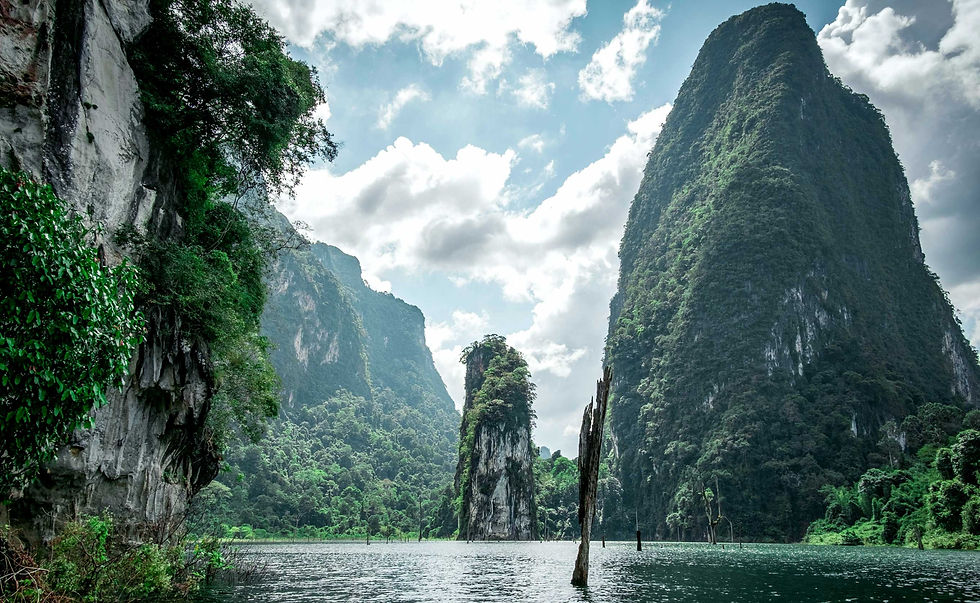
The dam is a fact worth sitting with when you take a longtail boat across the lake: the limestone towers rising out of the water were once hilltops, and what is now open water was once forest floor. This is one of the clearest physical reminders that the landscape is not untouched wilderness in the strict sense — it has been shaped by a specific engineering decision.
From concession to national park
Khao Sok was officially designated a national park in 1980, ahead of the dam's completion, placing the remaining forest under protection before further logging concessions could be renewed. This timing means the park's establishment and the end of large-scale logging in the area happened close together, though the forest's survival up to that point owed as much to the insurgency as to policy.
Since designation, the park has been managed by Thailand's Department of National Parks, Wildlife and Plant Conservation, which sets the rules on where you can hike, camp, and take a boat, and which areas remain off-limits to protect regenerating habitat.
What this history means for your trip
Knowing this background changes a few practical things about how you might plan a visit.
Choose guides who explain the landscape, not just walk you through it
A guide who can point out which sections were logged, which grew back after 1980, and which were never touched gives you a genuinely different experience than one who only names bird species. If you are comparing tour operators, it is worth asking what they cover before booking — you can read traveler reviews of Khaosok Discovery tours to see what past visitors say about the depth of the guiding.
Expect a mix of forest ages
Do not expect every part of the park to look like postcard old-growth rainforest. Some areas are recovering secondary forest, some are close to a century old. Both are worth seeing, for different reasons.
Respect the areas that are still closed to development
Not every part of Khao Sok is open to tourism, and that is deliberate. Sticking to marked trails and permitted lake zones supports the same regeneration that has been happening since 1980.
If you are ready to book a trip that takes this history into account, you can compare options through Khao Sok tours online, or read more Khao Sok Discovery tour reviews before deciding which route suits you.
For the official record on the park's protected status and management, see the Department of National Parks, Wildlife and Plant Conservation.
Summary
Khao Sok's forest survived not because it was protected early, but because a communist insurgency made it too dangerous for logging companies to work through the 1970s. When the fighting ended, the government designated the area a national park in 1980, just ahead of a dam project that would flood part of the original valley. The forest you walk through today carries all three chapters: old growth that escaped the saw, secondary growth that has recovered since, and a lake that covers what used to be solid ground.
Planning a visit with this in mind means choosing guides who can point out these differences, expecting variation in forest age across the park, and respecting the boundaries that keep the recovering sections intact.
Read the previous article: Khao Sok oldest rainforest older than Amazon: A Guide
Let's Plan Your Khao Sok Journey
Have questions about routes, timing, or which part of the park fits your trip? Send us a message and get advice from people who know the park.

Comments