Khao Sok limestone geology 160 million years old
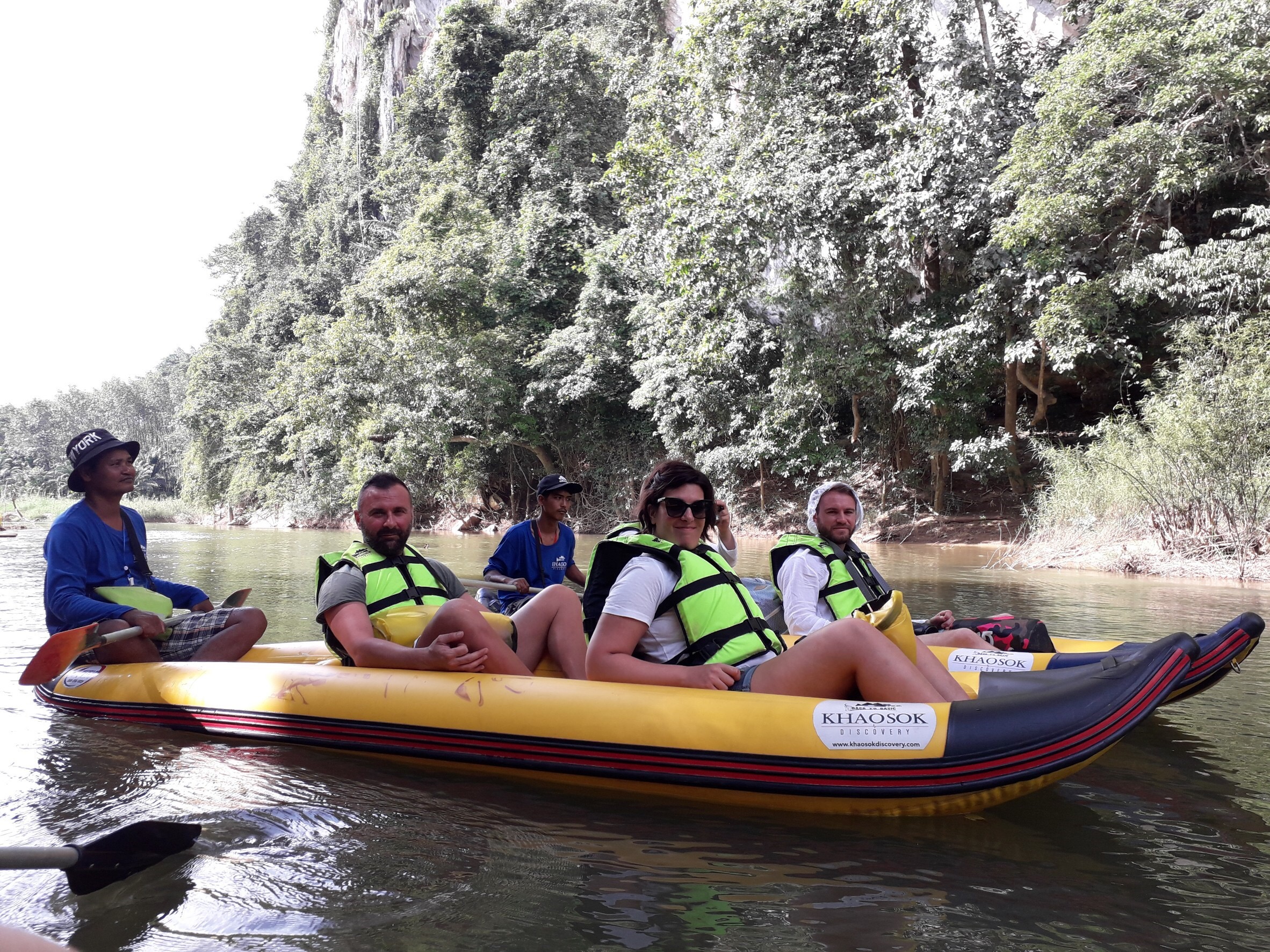
You spend most of a trek in Khao Sok looking up, at the cliffs, or ahead, at the trail. It is worth looking down too. The pale grey rock under your boots is limestone, and it did not start life as a mountain. It started as the floor of a sea, laid down 160 million years ago, one thin layer of shell and sediment at a time.
This article is about that rock: how it got here, what it looks like up close, and which features you can actually find on a normal day walk without a geologist standing next to you. By the end you will know what to look for the next time a cliff face or a cave wall is in front of you.
Some of this depends on the trail you take and how much light is on the rock that day. Where that matters, it's said plainly.
How Khao Sok's Limestone Was Born From an Ancient Sea
Reading the Rock: What 160 Million Years Looks Like Underfoot
Fossils and Mineral Traces You Can Actually Spot on the Trail
Caves, Cliffs and the Karst Landforms Shaping the Park Today
Summary: What the Rock Tells You Before You Even Start Walking
How Khao Sok's Limestone Was Born From an Ancient Sea
Limestone is built by living things, not by lava or by wind. Shells, coral fragments and the skeletons of tiny marine organisms settle on a seafloor, get compressed under the weight of everything piled on top of them, and slowly turn into rock. Khao Sok's limestone began this way roughly 160 million years ago, when the area now covered in rainforest was underwater.
What eventually pushed that seabed up into cliffs and peaks was millions of years of tectonic movement, the same slow collision of plates that shaped much of mainland Southeast Asia. The rainforest on top is comparatively young. The rock underneath it is not.
Why the rock is grey, not brown
Most of the soil-covered hills you might be used to elsewhere are made of sandstone or granite, which weather to brown and red tones. Limestone stays pale grey or white where it's freshly exposed, because it's mostly calcium carbonate from those old shells. A cliff face that looks bleached rather than earthy is usually your clue that you're looking at the same rock the whole park sits on.
Reading the Rock: What 160 Million Years Looks Like Underfoot
On flat sections of trail, especially where recent rain has washed the topsoil away, you'll sometimes walk over bare limestone directly. It looks layered, almost like a stack of pages, because it is one: each thin band is a separate deposit from a different point in that 160-million-year history.
Limestone also dissolves in slightly acidic rainwater, over time, far more than granite or sandstone does. That's what gives karst landscapes their particular shape: sharp ridgelines, sudden cliffs, and the sinkholes and underground drainage that don't really form in other rock types. If a section of trail looks eaten away rather than eroded smooth, that's the dissolution at work, not simple weathering.
Sharp edges versus rounded edges
A useful habit on the trail: run your eye over an exposed rock face and note whether the edges are sharp or rounded. Sharp, jagged edges usually mean the rock has broken recently, maybe from a rockfall. Rounded, smoothed edges mean water has been working on that surface for a long time, sometimes centuries.
Fossils and Mineral Traces You Can Actually Spot on the Trail
Because this limestone formed from marine life, fossil traces do turn up in exposed rock, most often as faint shell outlines or small embedded fragments rather than the dramatic, complete fossils you might picture from a museum display. They're easy to miss if you're moving at normal walking pace.
Mineral deposits are usually the more obvious find. Where water has been seeping through limestone for a long time, it can leave behind pale, almost waxy-looking mineral coatings on rock surfaces, particularly near cave mouths and damp overhangs. This is the same slow process that builds stalactites and stalagmites deeper underground, just visible here at the surface.
What not to expect
Don't go in expecting a fossil in every rock you pass. Most exposed surfaces show no visible fossil at all, and whether you spot one on a given day comes down to luck, light, and how recently that section of rock has been exposed by erosion or trail maintenance.
Caves, Cliffs and the Karst Landforms Shaping the Park Today
The caves scattered through Khao Sok are a direct result of this same limestone chemistry. Water finds a weak seam in the rock, dissolves it slightly wider over a long period, and eventually opens a passage large enough to walk through. Some of the park's cliffs show the early stage of this same process, as shallow overhangs and undercuts rather than full caves.
If you want to see this up close with some context from a guide rather than working it out yourself, a night safari trek often passes rock faces that are hard to appreciate in daylight glare, since low-angle light shows the layering more clearly. Daytime hikes covered in the park's general things to do guide will take you past several of these formations as a matter of course, without any extra planning needed on your part.
According to Thailand's national park authority, karst systems like this one also shape the park's underground water flow, which is part of why the rainforest above stays so consistently damp even outside the wet season — worth keeping in mind if you're comparing it to drier limestone landscapes elsewhere. You can read more from the source directly at the Department of National Parks, Wildlife and Plant Conservation.
Where the wildlife fits in
The caves and crevices in this limestone aren't just a geological curiosity, they're shelter. Several of the species covered in the park's wildlife encounters guide, particularly bats and some bird species featured in the birdwatching write-up, depend directly on these rock formations for roosting and nesting sites.
Summary: What the Rock Tells You Before You Even Start Walking
Khao Sok's cliffs, caves and pale grey rock faces trace back to a seabed that existed 160 million years ago, long before there was a rainforest, or a trail, or a boot to stand on it. The layering you see in exposed rock, the sharp versus rounded edges, the faint fossil traces and the mineral coatings near cave mouths are all readable signs of that history, if you slow down enough on the trail to look.
None of this requires special equipment or a geology background. It just changes what you notice on a walk you were probably already planning to take.
Read the previous article: Khao Sok oldest rainforest older than Amazon: A Guide
Let's Plan Your Khao Sok Journey
Tell us what you want to see, from the limestone trails to the caves and wildlife, and we'll help you build the right route.


Comments